Features and flows
See what exists, how it works, and where the experience differs. A feature checklist is the starting point; the actual journey explains the gap.
UX benchmarking
Compare your product with competitors, from the first ad to the everyday experience. See where you lead, where you fall behind, and which opportunities deserve your team’s attention.
Free 30-minute call. No commitment.
From feature coverage to the actual flow.
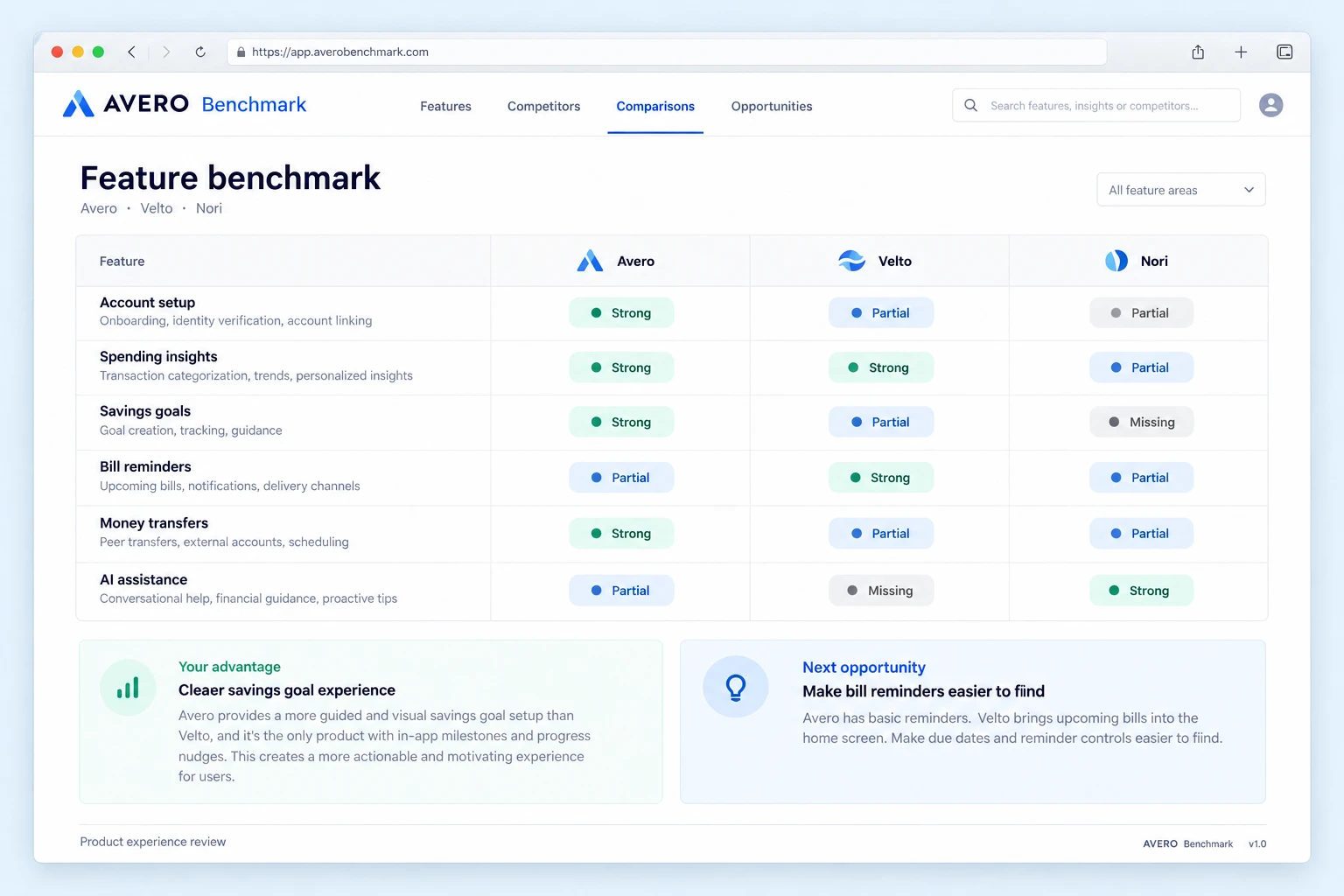
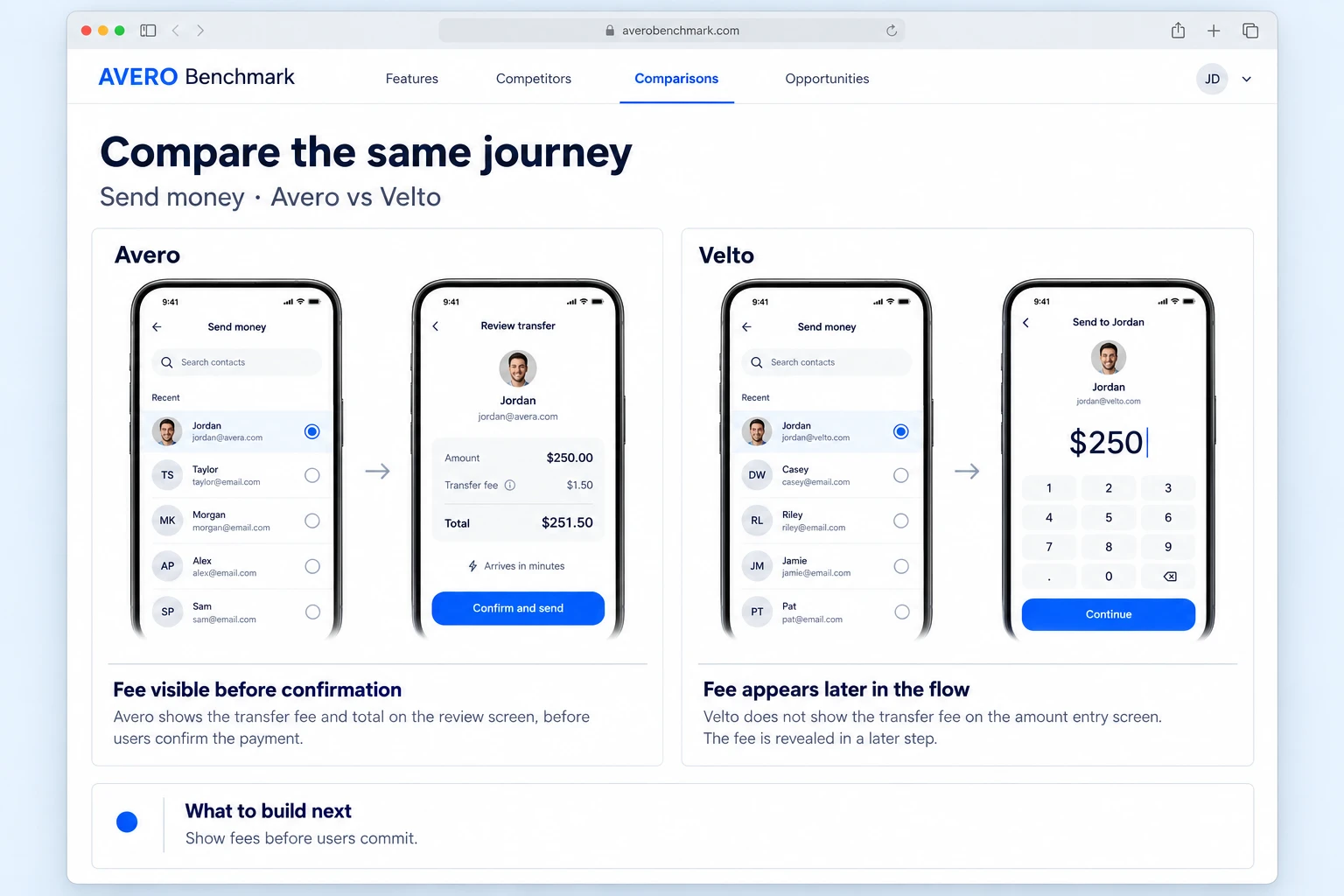
We start with the decisions your team needs to make. Together we define the product areas, competitors, user segments, platforms, and access. We then capture the experience as it works today, including key screens, entry points, decision states, and relevant marketing.
We compare equivalent tasks and user contexts using an agreed evaluation framework. Clarity, discoverability, interaction effort, trust, and recovery are assessed alongside feature coverage. Each assessment points to dated evidence, so your team can inspect the reasoning.
We translate the comparison into strategic advantages, experience gaps, and opportunities to validate. Recommendations connect the customer problem to your business priorities, with confidence, dependencies, and engineering input shaping what should happen next.
We walk product, design, marketing, and leadership through the findings, then hand over the editable benchmark and its structure. Your team can refresh evidence, extend the coverage, and use it in recurring product reviews.
Give your team a shared view of how the product actually works across features, journeys, and customer touchpoints. Each area connects to the screens, context, and observations behind it. The examples shown use fictional products: Avero, Velto, and Nori.

See what exists, how it works, and where the experience differs. A feature checklist is the starting point; the actual journey explains the gap.
Compare positioning, creative, calls to action, and the path from ad to landing page to product. Identify where the promise and experience diverge.
Turn observations into a focused backlog, with the evidence, rationale, and next validation step attached.
Two products can offer the same capability and deliver very different customer experiences. We examine how people discover a feature, understand its value, complete a task, and recover when something goes wrong.
Compare the same customer goal across products, with the user role, platform, account state, and access conditions recorded. This makes meaningful differences visible without confusing different contexts with better or worse design.
Findings link to captured screens, source references, and review dates. We distinguish observed behavior, expert interpretation, and questions that need research. Inaccessible or unverified functionality is recorded as unknown rather than assumed missing.
Review ads, positioning, landing pages, onboarding, and the experience that follows. The benchmark shows where expectations stay consistent, where value is hard to discover, and where a competitor communicates a similar capability more clearly.
As products grow, the customer experience becomes distributed across teams, roadmaps, and releases. The benchmark gives executives a shared reference for understanding what customers encounter and where investment could matter most.
Follow a journey across acquisition, onboarding, and everyday use. Leadership can see where strong individual features still create a fragmented experience, where teams are solving similar problems, and where ownership needs to be clarified.
Separate competitive parity from meaningful differentiation. Each recommendation explains the customer problem, supporting evidence, strategic relevance, and next validation step. Your team can weigh those inputs against cost, dependencies, and existing commitments.
Use the benchmark in planning, executive readouts, and design reviews. Drill from a high-level opportunity into the actual journey, compare alternatives, and record why a decision was made. Connect analytics and research where available to test the assessment.
The value grows when the benchmark becomes part of how your organization works. We structure the information for ongoing updates, reusable comparisons, and a clear path into your internal tools.
Features, journeys, competitors, findings, and recommendations have consistent fields and references. Capture dates, source links, and review status make the evidence easier to find, revisit, and maintain as products evolve.
Your team can connect structured benchmark records to an internal AI assistant through Model Context Protocol (MCP). With the integration configured, it can retrieve relevant evidence for questions such as “Where does our onboarding fall behind?” or “What supports this roadmap recommendation?”
We agree on the workspace and export structure with your team so the benchmark can support future integrations. MCP server implementation, permissions, hosting, and automated refresh are scoped separately. Your team receives the maintenance process and can extend the knowledge base over time.
Understand your advantages as clearly as your gaps. Use competitors as context while keeping customer needs at the center.
Bring design, product, and marketing into the same conversation with dated captures and consistent comparison criteria.
One setup, an editable workspace, and a repeatable update process. Your team owns the ongoing maintenance.
A UX audit diagnoses friction in your own experience. Benchmarking compares your product, journeys, and marketing with selected competitors to show relative strengths, gaps, and opportunities. The two can be scoped together.
We can map the full product or start with priority areas. We agree on products, platforms, user roles, screens, and states before work begins. Competitor coverage depends on accessible accounts and available journeys; any gaps are documented.
We use agreed criteria and comparable tasks, supported by captured screens and observations. Expert assessments are distinguished from measured behavior. Conversion, retention, or ad performance claims require supporting data; screenshots alone do not establish them.
Your team gets the editable benchmark and a walkthrough covering how to add evidence, update comparisons, and record capture dates. Ongoing monitoring is not included in the one-time setup; additional support can be scoped separately.
Yes, the benchmark can be structured as a source for retrieval through an MCP integration. We agree on the records, source references, and export format with your technical team. Connecting it to your AI environment requires an MCP server or compatible connector, appropriate access controls, and a refresh process. Integration work is scoped separately from the benchmark itself.
We quote based on product breadth, competitor count, access, and the depth of flow and marketing coverage. Deliverables, timing, and any workspace costs are confirmed before work starts.
Start with a free 30-minute strategy call. We’ll tell you honestly if this is the right fit.
Benchmark my product